
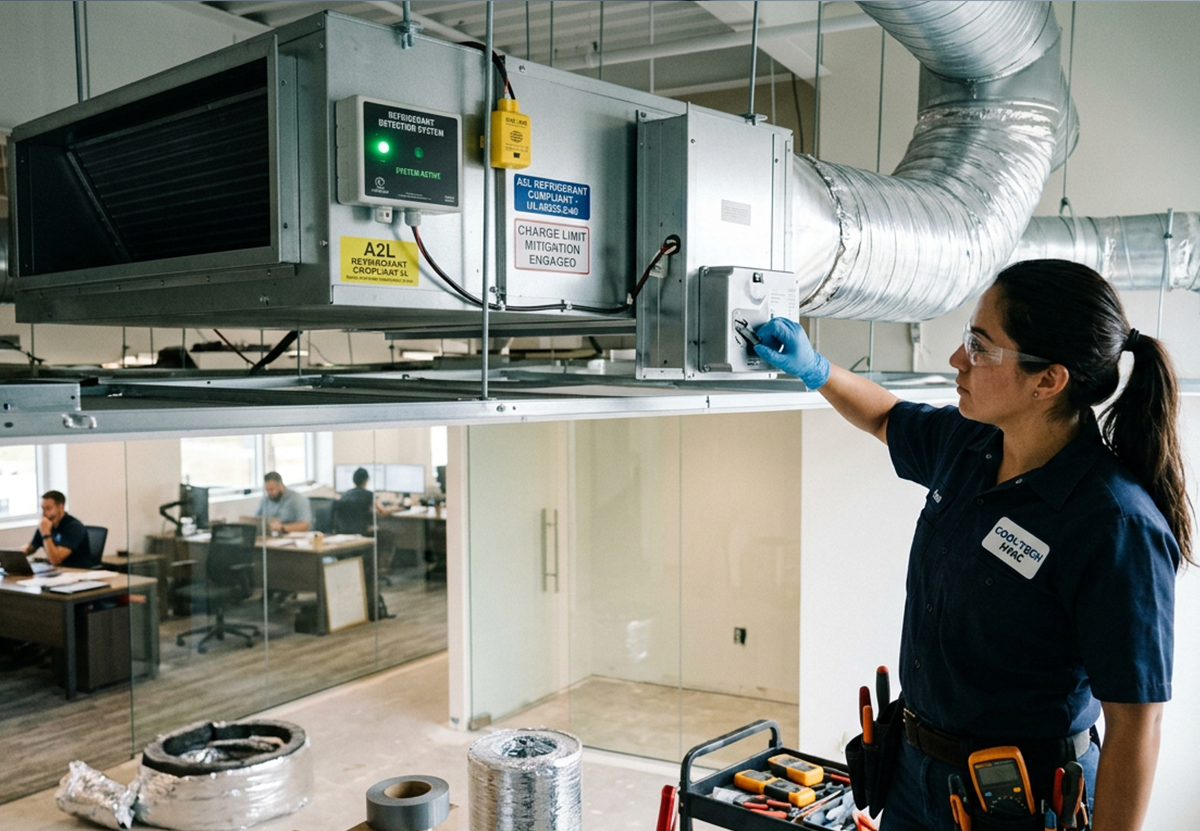
Are you preparing for the transition to A2L refrigerants like R-454B or R-32, only to realize your system’s refrigerant volume exceeds the maximum allowable charge limit for a small space? You are not alone. As strict efficiency mandates push our industry toward lower Global Warming Potential (GWP) options, HVAC contractors and system designers frequently run into a major hurdle: what do you do when a room’s square footage just isn’t large enough to safely hold the system’s full charge?
Exceeding the baseline charge limit doesn’t mean your installation is dead in the water, it simply means static safety measures are no longer enough. To stay compliant with updated ASHRAE 15 and UL 60335-2-40 standards, you need to understand what mitigation strategies are available and how to put them into practice.
In this guide, we will break down the essential mechanics of A2L leak detection systems and explore the four code-approved safety protocols engineered to dilute, isolate, or exhaust leaking gas. Whether you need to evaluate active fan dilution, mechanical ventilation, automatic shut-off valves, or zone-damper overrides, we will help you choose the right solution to protect your occupants, reduce flammability risk, and keep your installations fully compliant. Let’s dive in.
How does your HVAC system know when a microscopic pinhole leak threatens to turn an occupied space into a hazard? The answer lies in the brain of modern A2L equipment: the Refrigerant Detection System (RDS).
Before any active mitigation control can kick into gear, your system must first recognize what is happening at the molecular level. Understanding how these sensors continuously track gas levels and what triggers them, is the foundation of every safe, code-compliant installation under ASHRAE 15 and UL 60335-2-40 standards.
The Magic Number: Understanding the 25% LFL Threshold
A2L refrigerants like R-454B and R-32 are classified as mildly flammable. They require a specific concentration in air, combined with a high-energy ignition source, to burn. That critical boundary is known as the Lower Flammability Limit (LFL).
Safety codes don’t wait for gas levels to get anywhere near that dangerous line. Instead, standard compliance is explained through a strict safety margin:
- The Trigger Point: Active controls must initiate the moment refrigerant concentration reaches < 25 % of the LFL.
- The Safety Buffer: By triggering at a quarter of the flammability limit, the system buys crucial time to dilute or isolate the gas long before it poses a real-world threat to occupants.
Factory-Installed vs. Field-Integrated Sensors: Where Do They Go?
Because A2L gases are heavier than air, they don’t disperse evenly on their own, they sink and pool near the floor. To track leaks effectively, sensors must be placed strategically based on system design:
- Factory-Installed Sensors: Placed directly inside the air handler or evaporator coil cabinet by the manufacturer. These catch leaks at the primary source, the internal coil, before gas ever enters the ductwork.
- Field-Integrated Sensors: Added by technicians in low-lying areas, enclosed mechanical closets, or small rooms served by unducted mini-splits where gas accumulation is most likely.
Seconds Count: From Gas Detection to Instant Action
What happens when a sensor detects a leak exceeding the 25% threshold? Speed is everything.
- Detection: The sensor detects refrigerant molecules and sends an immediate fault signal to the main control board.
- Verification: The onboard logic verifies the reading within seconds to eliminate false alarms.
- Command Execution: The system overrides standard thermostat calls and instantly engages safety measures whether that means spinning up the supply blower, shutting isolation valves, or dumping gas outdoors.
By relying on fast-acting, continuous sensing, you ensure that even if a system’s charge exceeds baseline limits, the space remains protected around the clock.
The 4 Code-Approved Mitigation Strategies
- Active Air Circulation (Continuous Blower Operation)
- What it does: The leak sensor triggers the indoor air handler fan to immediately run at full speed.
- Why it works: A2L refrigerants (like R-454B or R-32) are heavier than air and sink to the floor. Continuous forced air dilutes heavy gas pockets across the entire room volume, keeping the concentration well below 25% of the Lower Flammability Limit (LFL).
- Dedicated Mechanical Exhaust Ventilation
- What it does: Activates a dedicated exhaust fan to pull contaminated air directly out of the building.
- Why it works: Essential for tight, enclosed spaces or mechanical rooms with no connected ductwork, venting leaking gas outdoors while bringing in fresh makeup air.
- Automatic Safety Shut-Off Valves (SSOVs) & System Pump-Down
- What it does: Motorized isolation valves located on the liquid and suction lines automatically close outside the occupied space.
- Why it works: Traps the majority of the system’s refrigerant charge outdoors or in the line set, preventing the entire charge from dumping into a small indoor space.
- Automated Zone-Damper Overrides
- What it does: Forces open electronically controlled dampers across all zones in multi-zone or VAV systems.
- Why it works: Prevents leaking refrigerant from being trapped inside a single small room by instantly expanding the Effective Dispersal Volume across all connected rooms.
What Comes Next for the HVAC Trade
As state building codes update and existing equipment inventory clears out, compliance is no longer optional, it is an operational requirement. System designers, technicians, and code officials must pivot from viewing leak detection as an optional accessory to treating it as an integrated safety control system.
Take the Next Step on Your Projects
- Audit Your Calculations: Always calculate minimum required room volume using the line-set length addition, not just the factory unit charge.
- Verify System Listings: Ensure replacement units with internal Refrigerant Detection Systems (RDS) match the equipment manufacturer’s approved listing under UL 60335-2-40.
- Train Your Teams: Equip field technicians with the tools and knowledge required to test and commission active mitigation controls before putting systems into service.
Stay Ahead of the Curve: Don’t let charge limit surprises delay your job sites. Partner with certified manufacturers, stay up to date on local ASHRAE 15 adoption rules, and design every installation with safety and compliance built in from day one.