
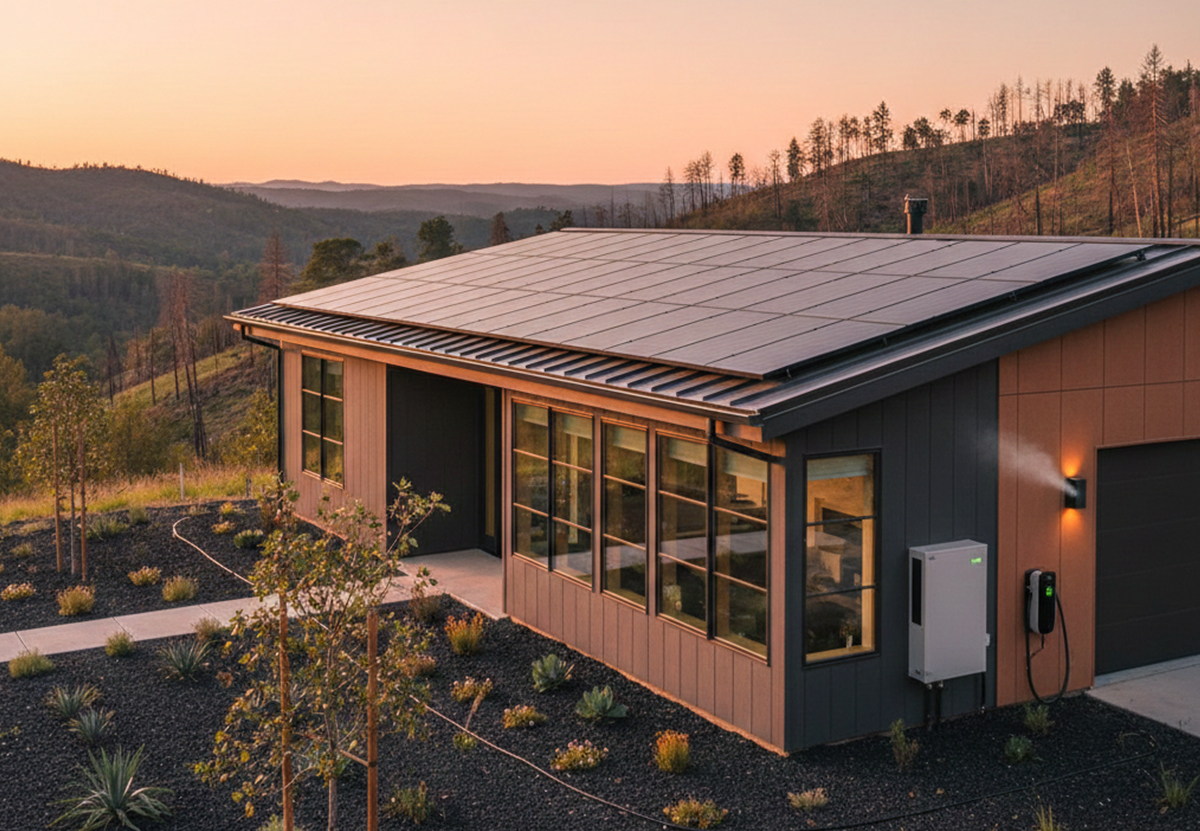
Building back after a wildfire is more than just a restoration of what was lost; it is a critical opportunity to construct a home that is fundamentally “future-proof.” With California’s 2025 Energy Code (Title 24, Part 6) set to take effect for permits filed on or after January 1, 2026, the blueprint for fire recovery has shifted from simple survival to Net-Zero Carbon performance.
For homeowners in recovery, this code provides a roadmap to bridge the gap between fire resilience (hardening the exterior) and energy independence (powering the interior).
1. The Core Strategy: “Net-Zero” Meets Fire Hardening
A “Net-Zero” home produces as much energy as it consumes annually. In a fire-recovery context, this means the home isn’t just efficient, it’s a fortress of self-sufficiency. The 2025 Code accelerates this by making all-electric baselines the new standard.
Heat Pump Baselines: The code now defaults to heat pumps for both space and water heating. For fire zones, this removes gas lines, a primary hazard during seismic activity or wildfire events.
Electric Readiness: Even if you choose to install a gas range for sentimental or gourmet reasons, the 2025 Code requires dedicated 240V circuits to be pre-wired behind all major appliances. This ensures that if the grid or gas supply is compromised in a future disaster, transitioning to full electrification is a “plug-and-play” fix.
2. Solar + Storage: The Recovery Powerhouse
After a wildfire, grid reliability is often a major concern. The 2025 Code expands requirements for Photovoltaic (PV) systems and, crucially, Battery Energy Storage Systems (BESS).
3. Beyond the Envelope: Indoor Air Quality & Smoke Resilience
One of the most significant “invisible” upgrades in the 2025 Code is the focus on Indoor Air Quality (IAQ). For homes in fire-prone areas, smoke is a recurring threat even when the flames are miles away.
- Balanced Ventilation: The new code favors Heat Recovery Ventilators (HRVs) and Energy Recovery Ventilators (ERVs). These systems provide a continuous stream of fresh, filtered air while retaining up to 60-80% of the indoor temperature.
- MERV 13 Filtration: High-efficiency filtration is now a standard expectation. In a net-zero home, the envelope is sealed so tight that mechanical ventilation becomes the “lungs” of the house, filtering out fine particulate matter (PM2.5 Particles) from wildfire smoke.
4. The “Zone 0” Factor: Integration with Fire Codes
While Title 24 governs energy, the CAL FIRE “Zone 0” regulations (updated in 2025) govern the first five feet around your home. A Net-Zero Fire Recovery Home succeeds when these two codes overlap:
- Non-Combustible Envelopes: Using high-performance, non-combustible materials like fiber cement or metal siding satisfies both the fire hardening of Zone 0 and the high-insulation (U-factor) requirements of the Energy Code.
- Ember-Resistant Vents: New attic ventilation standards require “smart” vents that allow air for energy efficiency but close automatically when they sense the heat of an approaching fire.
Pro Tip: If you are rebuilding after a federally declared disaster, check for Title 24 exemptions regarding solar requirements. While the 2025 code is strict, some recovery projects can apply for “Solar PV” waivers if the cost-effectiveness is skewed by the disaster recovery context, though most builders recommend installing solar anyway to reach that net-zero goal.
How can I help you further?
Rebuilding is a complex journey involving architects, energy consultants, and HERS raters. Would you like me to create a checklist of specific 2025 Energy Code questions you should ask your contractor or architect during the design phase?
Start your wildfire recovery with a team that understands California’s 2025 Energy Code, Title 24 compliance, and fire hardening from day one.
Call (310) 935-3773 or visit www.K2D.com to design a safer, energy-independent home built for the future.
