
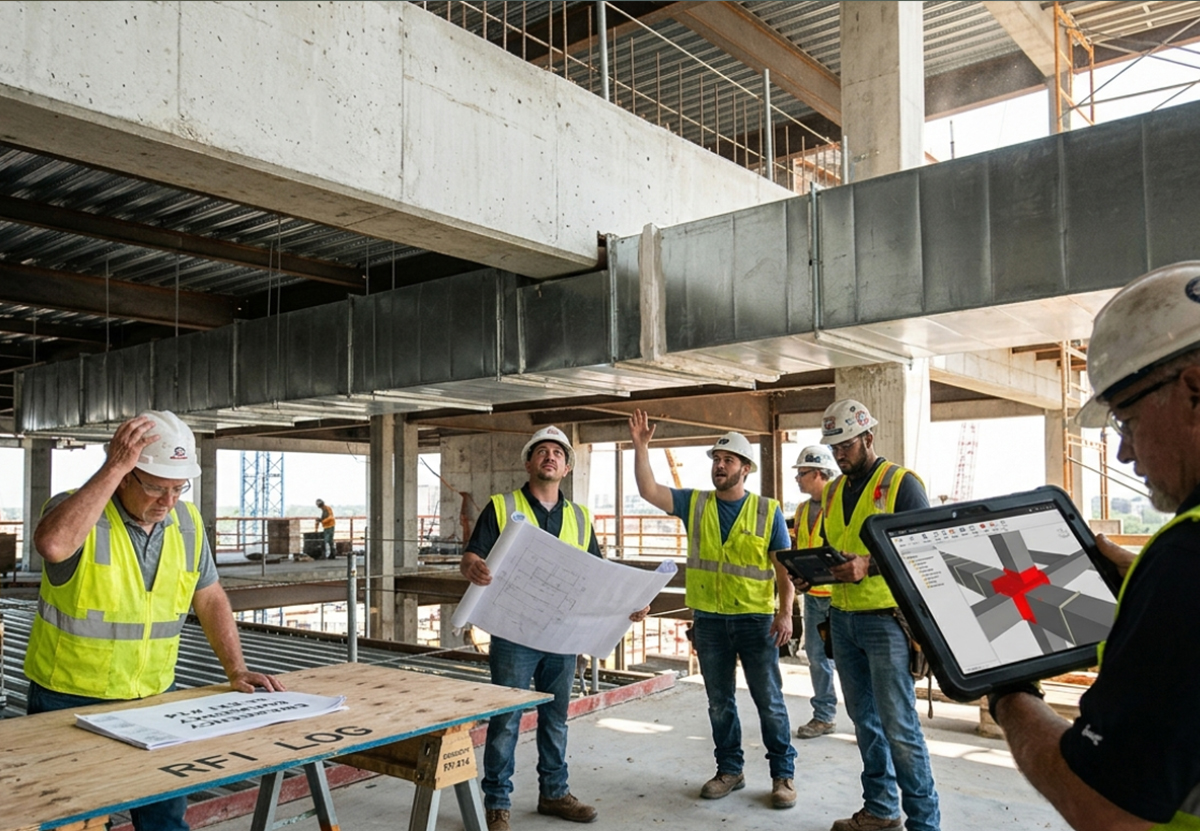
Have you ever watched a construction project grind to a sudden, screeching halt because two lines on a flat drawing tried to occupy the exact same physical space in the real world?
Picture this: Your framing crew has just poured a massive, load-bearing concrete structural beam. The concrete is cured, the structural integrity of the floor is locked in, and the project is moving right on schedule. But then, the mechanical team arrives on-site to hang a giant, custom-fabricated steel ventilation duct. They pull out their laser measures, look up, and freeze. The ductwork is headed on a direct, unavoidable collision course straight through the center of that concrete beam.
In a traditional 2D design workflow, this is the ultimate spatial trainwreck. You cannot simply hack a massive hole through a primary structural element without jeopardizing the stability of the entire building. Yet, you also cannot leave an entire floor without heating or cooling.
So, what happens next?
Historically, this exact moment triggers an expensive chain reaction of emergency field reworks, heated finger-pointing, and endless paperwork that drains a developer’s budget. But it doesn’t have to be this way. Modern construction relies on 3D building information modeling to catch these spatial nightmares in a virtual environment long before a single ounce of concrete is ever poured.
By prioritizing proactive structural and MEP alignment during the pre-construction phase, forward-thinking teams are changing the narrative. In this article, we will unpack the true, compounding costs of hitting a structural beam in the field, explore how engineering teams utilize intelligent software to master 3D spatial coordination, and look at the undeniable financial proof that digital foresight is a contractor’s absolute best defense against project delays.
The Anatomy of a Spatial Trainwreck
Have you ever looked at a set of traditional 2D construction prints and felt completely confident that everything would fit perfectly on-site? It’s an easy trap to fall into. On a flat screen or a layered piece of paper, a major mechanical duct and a massive concrete beam can look perfectly fine crossing paths. The lines intersect seamlessly, the dimensions seem to check out, and the project gets greenlit for production.
But flat drawings inherently lack depth. They create a dangerous illusion of compatibility that completely falls apart the moment you transition from a digital desktop to a physical job site. When you are relying solely on flat sheets, you are essentially asking your field crews to play a high-stakes game of three-dimensional Tetris, except the pieces weigh thousands of pounds and cost a fortune to replace.
When Steel Meets Load-Bearing Concrete
To understand why these design oversights are so destructive, we have to look at how different architectural elements interact. In the construction world, spatial conflicts generally fall into two categories: a hard clash vs soft clash.
While a soft clash involves an object invading a geometric buffer zone needed for maintenance or safety clearances, a hard clash is a literal, physical impossibility. It occurs when two components are detailed to occupy the exact same physical space simultaneously.
When your mechanical guy’s giant ventilation duct runs directly into a primary concrete structural beam, you are looking at a classic, high-risk hard clash. Why is this specific collision such a nightmare?
- Immovable Objects: A load-bearing concrete beam is cast with heavy rebar reinforcement to support the dead and live loads of the building. It cannot be altered, notched, or cored without risking structural failure.
- Unyielding Systems: Large-scale commercial HVAC ducts require specific, continuous paths to maintain air pressure and velocity. You cannot simply bend them at sharp angles around a beam without destroying the system’s efficiency.
- The Ultimate Deadlock: Because neither element can yield to the other in the field, progress on that entire section of the floor comes to an immediate, grinding halt.
The Field Disruption: Halting Progress and Finger-Pointing
What actually happens on the ground the moment your crews discover that a duct is trying to punch through a solid beam? The atmosphere on-site shifts instantly from productive momentum to tense damage control.
First, the installing trade has to drop their tools. They cannot proceed, which means an entire crew of specialized, high-wage installers is suddenly idled. But the disruption doesn’t stop with the mechanical team. Because the overhead routing is compromised, the framing crews, drywallers, and electrical subcontractors who were scheduled to follow right behind them are blocked.
As schedules begin to slip, the inevitable blame game begins. Is it the mechanical designer’s fault for routing the duct there? Or is it the structural engineer’s fault for thickening the beam? When you are chasing deadlines, finger-pointing only wastes more precious time.
[2D Blueprint Design] ──> [Field Discovery of Clash] ──> [Work Stoppage & Idled Crews] ──> [The Blame Game]The Administrative Nightmare: Tracing the Emergency RFI Paper Trail
Once the initial shock wears off, the tedious administrative machine kicks into gear. You cannot fix a structural conflict on a whim; it requires a formal, legally binding paper trail to determine a solution and assign financial responsibility.
This process centers around the dreaded emergency Request for Information (RFI). Here is how that administrative bottleneck typically plays out:
- The Subcontractor Flags It: The mechanical foreman writes up a formal RFI detailing the physical obstruction.
- The General Contractor Reviews It: The GC logs the RFI and forwards it to the architectural and engineering teams.
- The Design Team Scrambles: The structural engineer and the MEP designer must review their original models, calculate a workaround, and ensure the new layout doesn’t trigger another clash somewhere else.
- The Formal Response: Days or sometimes weeks later, an approved redesign is issued back down the chain of command.
By failing to prioritize proactive structural and MEP alignment during the earliest stages of planning, a project can easily rack up dozens of these emergency RFIs. Every single day that an RFI sits on a desk waiting for a signature, your labor costs climb, your timeline stretches, and your profit margins shrink.
Achieving true project efficiency requires a shift in perspective. Instead of reacting to these physical roadblocks with emergency paperwork, forward-thinking teams rely on 3D spatial coordination to identify, analyze, and resolve these exact conflicts virtually, months before the first construction vehicle ever rolls onto the site.
Here is a summary of the key takeaways from our exploration of construction clashes, along with a forward-looking call to action for your upcoming content.
What We’ve Learned
- The 2D Blindspot is Costly: Relying solely on traditional 2D flat drawings creates a dangerous illusion of compatibility. Complex mechanical, electrical, and plumbing (MEP) systems routinely collide with immovable structural elements like concrete beams when design lacks three-dimensional depth.
- The Chain Reaction of a Field Clash: Discovering a hard clash live on the job site is a project manager’s worst nightmare. It triggers immediate work stoppages, idles high-wage specialized crews, sparks defensive finger-pointing, and kicks off a sluggish, bureaucratic Request for Information (RFI) paper trail.
- Compounding Financial Damage: The true cost of hitting a beam extends far beyond the price of a scrapped duct. It drains developer profit margins through custom material waste, cascading schedule delays across multiple trades, and expensive, emergency change orders.
- The BIM Shield: Resolving spatial conflicts digitally via 3D Building Information Modeling (BIM) software costs nothing but a few clicks of a mouse. Proactive clash detection acts as a financial shield, empirically proven to slash design-related change orders by nearly half and deliver massive returns on investment (ROI).
The Future Outlook: Zero-Tolerance for Field Rework
As construction timelines tighten and building systems become increasingly complex, the industry is rapidly moving toward a zero-tolerance policy for preventable field errors. Digital twins and automated clash detection are no longer luxury tech add-ons reserved for mega-projects; they are foundational requirements for modern project delivery. In the near future, developers and general contractors will view skipping virtual coordination as an unacceptable financial gamble.
Fix It on the Screen, Not on the Job Site
Don’t wait for a frantic, early-morning phone call from a frustrated field foreman to realize your blueprints are flawed. Protect your project’s bottom line, keep your construction schedules aggressive, and foster seamless collaboration among your trades by mandating comprehensive 3D spatial coordination during pre-construction.
Investing in intelligent BIM coordination today means ensuring that when your teams step onto the job site tomorrow, they are there to build, not to fix design mistakes that could have been solved months ago with a mouse click.