
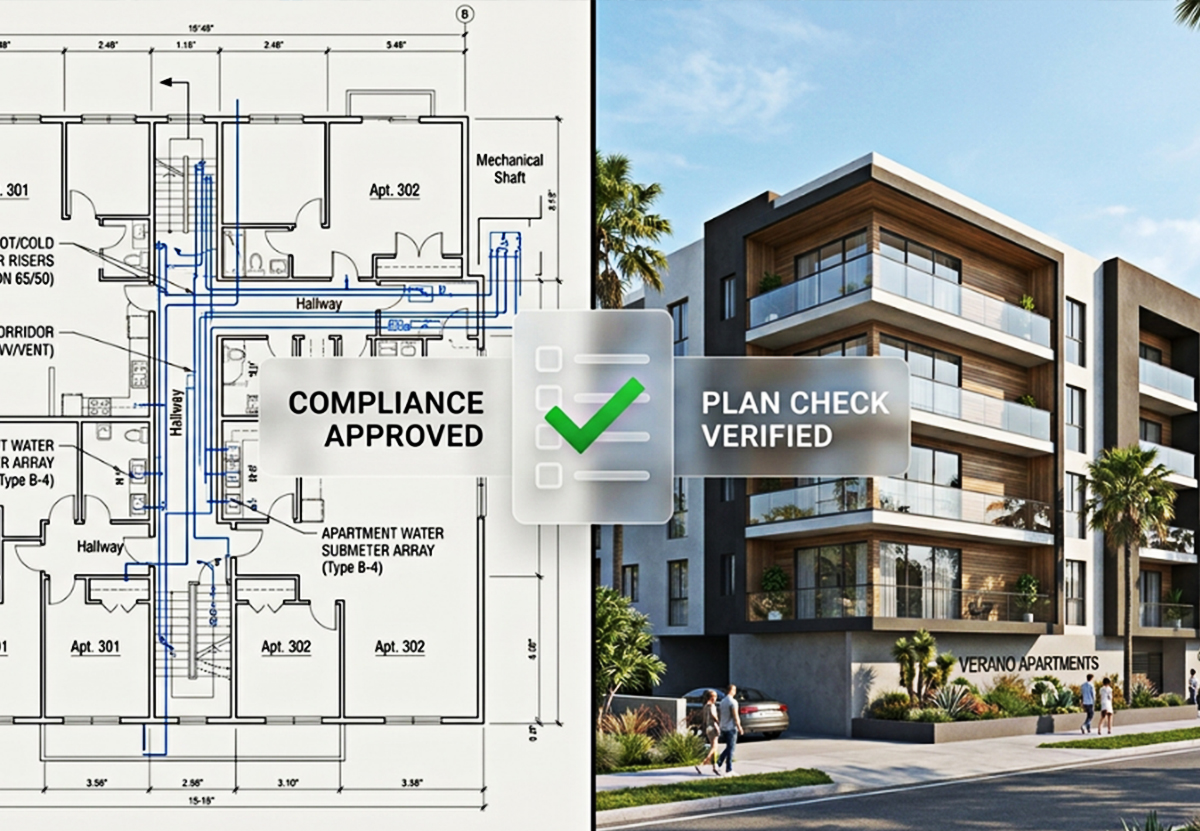
Are you certain your next multi-family layout actually requires individual water meters, or are you about to cost your client thousands in unnecessary hardware design?
In California’s hyper-regulated development landscape, navigating the strict requirements of multi-family submetering laws has become a standard hurdle for any design team. Ever since Senate Bill 7 codified structural mandates into California Water Code Section 537, the knee-jerk reaction for many architectural and MEP teams has been to simply specify individual submeters across every blueprint. But blanket designing can quickly derail your project budget and spatial efficiency. The reality is that California law acknowledges that individual metering isn’t a one-size-fits-all solution.
The state has established distinct legal loopholes, varying from affordable housing submeter exemptions to complex provisions for student housing and long-term care facilities. As an architect or developer, understanding how to strategically identify and claim these exemptions before you cross the plan check threshold can save massive amounts of square footage, eliminate mechanical coordination headaches, and streamline your path to approval.
How do these regulations impact your current pipeline? In this guide, we will break down the precise boundaries of California SB 7 exemptions, clarify how the Department of Housing and Community Development (HCD water submeter regulations) handles structural compliance, and give you the exact blueprint needed to secure your next water submetering plan check approval without municipal delays.
Understanding the Legal Loopholes: Key Exemptions Under Water Code Section 537
When you are deep in the weeds of schematic design, it is easy to assume that every multiunit housing project is subject to the exact same rigid plumbing constraints. But before you have your MEP team map out complex plumbing risers and dedicated meter closets for every individual unit, you need to look closely at the actual text of California Water Code Section 537.
The state of California recognizes that in certain structural and socioeconomic environments, individual unit submetering just doesn’t make practical or financial sense. To save your team from unnecessary design hours and protect your client from major hardware expenses, you should verify if your project qualifies for one of these primary exemptions:
- Affordable Housing & Tax-Credit Properties: If your development is classified as low-income housing, meaning it is financed through a low-income housing tax credit, tax-exempt mortgage revenue bonds, or specialized state and federal grants, it is completely exempt from the submetering mandate. Claiming an affordable housing submeter exemption can drastically lower your initial capital expenditure while keeping the project aligned with its budgetary goals.
- Student Dormitories and Institutional Housing: Housing located at a place of education (as defined by Title 24 of the California Building Standards Code) does not require individual unit meters. If you are designing student apartments, you can bypass individual billing infrastructure entirely.
- Long-Term Health Care & Residential Care Facilities: Facilities dedicated to extended medical care or licensed residential care for the elderly are formally exempt. Because these projects function more like healthcare infrastructure than standard apartments, the law waives the submetering requirement to simplify
facility operations.
What About Accessory Dwelling Units (ADUs)?
Are you working on a multi-family property that is simply adding a detached or attached backyard cottage? You are in luck. In many major California jurisdictions, the state’s submetering requirements do not apply to projects that are strictly constructing Accessory Dwelling Unit (ADU) water submetering systems. This keeps minor residential expansions fast, affordable, and free from municipal red tape.
By identifying these exemptions during the early programming phase, you can step into your local building department with confidence, knowing exactly where your project stands before your plans ever hit a reviewer’s desk.
Mastering SB 7 Compliance
- Submetering is Not One-Size-Fits-All: While California mandate dictates individual unit metering for new multi-family builds, Water Code Section 537 establishes clear boundaries where submetering is legally waived.
- Know Your Exemptions: Projects utilizing low-income housing tax credits, student dormitories, and long-term care facilities qualify for explicit exemptions that can protect your project’s bottom line and structural footprint.
- Early Phase Verification Protects Assets: Catching these compliance nuances during early programming, rather than at the plan check desk, prevents costly structural redesigns and hardware integration mistakes.
Future Outlook
As California’s water conservation frameworks continue to tighten, building departments are scrutinizing submeter placement, “legal-for-trade” hardware compliance, and accessibility criteria with greater precision than ever before.
Don’t let an unverified submetering plan delay your next groundbreaking. Partner with an experienced MEP engineering team early in the schematic design phase to evaluate your project boundaries, streamline your local water purveyor approval packages, and safeguard your architectural layouts.
Ready to eliminate plan check bottlenecks? Contact our engineering team today to review your project’s submeter strategy before your next municipal submission!