
Have you ever looked at a building blueprint and wondered how a structure with zero natural gas infrastructure could possibly survive a blistering heatwave or a freezing winter night while keeping the lights on?
For decades, natural gas was the comfortable baseline for space and water heating. But as California aggressively tightens its climate goals, relying on fossil fuel lines has quickly shifted from an industry standard to a major liability. If you are an architect, developer, or MEP engineer working anywhere in the Golden State, you already know the stakes: navigating the strict compliance hurdles of title24 Part 6 is no longer just about checking a few boxes. It is about completely rethinking how we design the modern building envelope.
The ultimate test of a modern all-electric design usually comes down to one high-stakes question: how do you deliver reliable, high-temperature domestic hot water and reliable climate control without triggering massive energy penalties?
Historically, the debate has centered on a fundamental mechanical fork in the road: a centralized vs. distributed heating architecture. Do you consolidate your entire mechanical infrastructure into a massive, high-efficiency central plant, or do you decentralize the load by placing smaller, localized systems directly at the point of use?
The choice you make drastically impacts everything from your upfront structural costs to your long-term energy modeling margins. In this deep dive, we are going to unpack the engineering strategies behind all-electric envelope optimization, look at real-world case studies, and explore how to design heat pump systems that don’t just clear the state’s performance hurdles, but actively future-proof your building against a rapidly changing energy grid. Turn off the gas, grab a coffee, and let’s dive in.
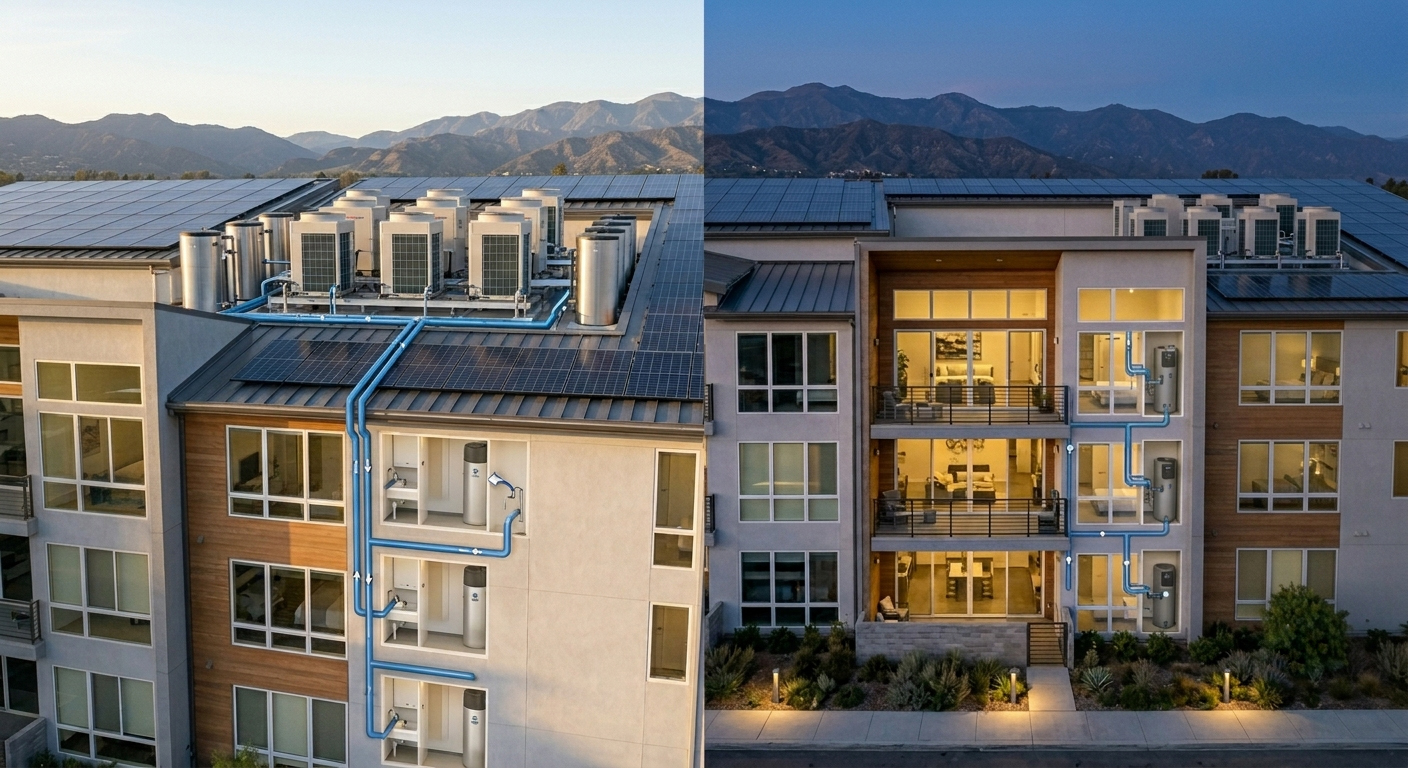
When designing modern multi-family or commercial buildings, mechanical engineers face a critical architectural decision: choosing a centralized vs. distributed domestic hot water framework. Both configurations offer distinct pathways to achieving high-efficiency performance, but their impacts on MEP spatial coordination, installation costs, and energy compliance margins vary significantly.
In a central design, a unified plant generates and manages the hot water for the entire building. This centralized system utilizes heavy-duty commercial heat pumps paired with large thermal storage tanks, typically located in a dedicated mechanical room or on the roof. On the other hand, a distributed approach decentralizes this infrastructure, placing smaller, localized heat pump units closer to the point of use, such as individual apartments, office clusters, or specific usage zones.
Choosing the right layout is no longer just about spatial constraints; it is a critical factor in clearing strict energy budgets. Under California’s title24 standards, the thermal efficiency losses of your distribution piping are heavily penalized. A poorly insulated or overly complex recirculation loop in a centralized layout can drastically drag down compliance margins, whereas a distributed setup eliminates these distribution losses entirely but introduces multiple compressor maintenance points throughout the property.
To determine the most efficient pathway, engineering teams must evaluate a balance of upfront capital expenditure, long-term operational costs, and peak demand profiles. Let’s look at a practical case study comparison to see how these two systems stack up in real-world application.
Centralized vs. Distributed Engineering Breakdown
| Design Factor | Centralized System | Distributed System |
| Piping & Distribution Losses | High (Requires continuous recirculation loops) | Negligible (Short, direct pipe runs) |
| Maintenance Profile | Low (Single, consolidated MEP room) | High (Multiple localized compressors to service) |
| Compliance Strategy | Relies on high-efficiency bulk plants (e.g., CO² refrigerants) | Relies on eliminating loop losses to satisfy title24 |
| Structural/Spatial Impact | Requires dedicated heavy-load floor space or roof reinforcement | Requires widespread utility closets and localized venting |
Choosing the Right Framework: Centralized vs. Distributed Engineering
When you are deep in the design phase of a modern all-electric development, you will inevitably hit a fork in the road. How do you deliver thousands of gallons of hot water across a massive footprint without the brute-force heating power of a traditional natural gas boiler?
This is the exact moment where your mechanical layout makes or breaks your energy model. The choice between a centralized vs. distributed architecture isn’t just about finding square footage on a floor plan; it is a high-stakes decision that dictates your entire MEP coordination strategy and ultimate project compliance.
So, how do these two configurations actually stack up when put to the test?
The Case for Centralized Systems: Bulk Power and Simplified Maintenance
In a central plant layout, you are consolidating your mechanical muscle into a single, dedicated location,usually a roof deck or a basement utility room. This setup relies on heavy-duty commercial heat pump water heaters working in tandem with large thermal storage tanks to serve the entire building.
Why do engineering teams consistently lean toward this approach?
- Consolidated Maintenance: Your servicing footprint is restricted to one room. Your operations team doesn’t need to enter individual tenant spaces to fix a compressor or flush a tank.
- Advanced Refrigerant Integration: Central plants make it incredibly cost-effective to utilize cutting-edge, eco-friendly refrigerants like CO² (R-744), which excel at creating high-temperature hot water in a single pass, even in freezing ambient conditions.
- Load Shifting Potential: With a massive unified thermal storage bank, you can easily program the system to “overheat” water during cheap, solar-heavy midday hours, allowing the building to ride through expensive peak demand windows without drawing grid power.
The Case for Distributed Systems: Eliminating the Loop Penalty
Now, let’s look at the alternative. A distributed approach entirely flips the script by decentralizing your infrastructure. Instead of one massive plant, you are placing smaller, localized heat pump units directly inside or adjacent to individual units, office clusters, or specific usage zones.
If you are fighting a tight compliance margin under California’s strict energy codes, a distributed design offers a brilliant tactical advantage:
- Zero Recirculation Losses: Because the heat pump sits mere feet from the shower or faucet, you completely eliminate the need for a continuous, building-wide hot water recirculation loop.
- Bypassing the Title 24 Loop Penalty: In the state’s compliance software, thermal distribution losses from massive piping networks are heavily penalized. By going distributed, you erase those piping losses from the math entirely, giving your title24 modeling a massive, automatic boost.
- Tenant Utility Autonomy: In multi-family housing, localized units allow for direct utility sub-metering, shifting operational energy costs directly to the occupant based on their actual consumption.
Striking the Ultimate Balance
Which path is right for your next project? If your priority is low long-term maintenance and capitalizing on smart grid load-shifting incentives, a central plant is tough to beat. But if you are working on a sprawling architectural footprint where long pipe runs would create an absolute nightmare of thermal degradation and drop your title24 margins into the red, a decentralized approach might just be your saving grace.
Ultimately, the right answer depends on a careful analysis of your building’s unique peak demand profile, structural weight allowances, and spatial constraints. By auditing these factors early, you can design a system that doesn’t just clear the regulatory hurdles, but genuinely performs efficiently for decades to come.
Transitioning to a fully decarbonized, all-electric building envelope is no longer a forward-thinking choice, it is the baseline for modern engineering. Designing without natural gas lines requires a tight, symbiotic relationship between passive architectural features and innovative mechanical systems.
Key Takeaways
- Envelope First: Minimizing thermal loads through high-performance continuous insulation, optimized window-to-wall ratios, and strict air barrier integrity is the foundation for reducing mechanical system sizing and cost.
- The DHW Architecture Crossroads: Choosing between a centralized vs. distributed hot water layout requires a careful balance of MEP spatial constraints, maintenance preferences, and title24 distribution loop penalties.
- Leveraging Advanced Tech: Utilizing variable-speed heat pumps, low-ambient CO² refrigerants, and dedicated outdoor air systems (DOAS) is critical to maintaining a high Coefficient of Performance (COP) without relying on inefficient electric resistance backups.
- Grid-Interactive Flexibility: True compliance margin success lies in designing smart buildings that utilize thermal energy storage (TES) and batteries to shift energy consumption away from high-TDV peak hours.
Future Outlook & Action Plan
As California’s energy grid evolves, the performance hurdles of title24 will only grow steeper. The future belongs to grid-harmonized buildings that act as active participants in the energy ecosystem rather than passive consumers.
For engineers, architects, and developers, the path forward requires early-stage collaboration. Do not wait until the architectural layouts are locked to bring your MEP and energy modeling teams to the table. Audit your building’s specific thermal envelope, evaluate a centralized versus decentralized infrastructure case, and begin engineering for a clean, gasless future today.
Are you ready to optimize your next all-electric project? Reach out to our engineering team to map out a high-performance compliance strategy tailored to your building design.