
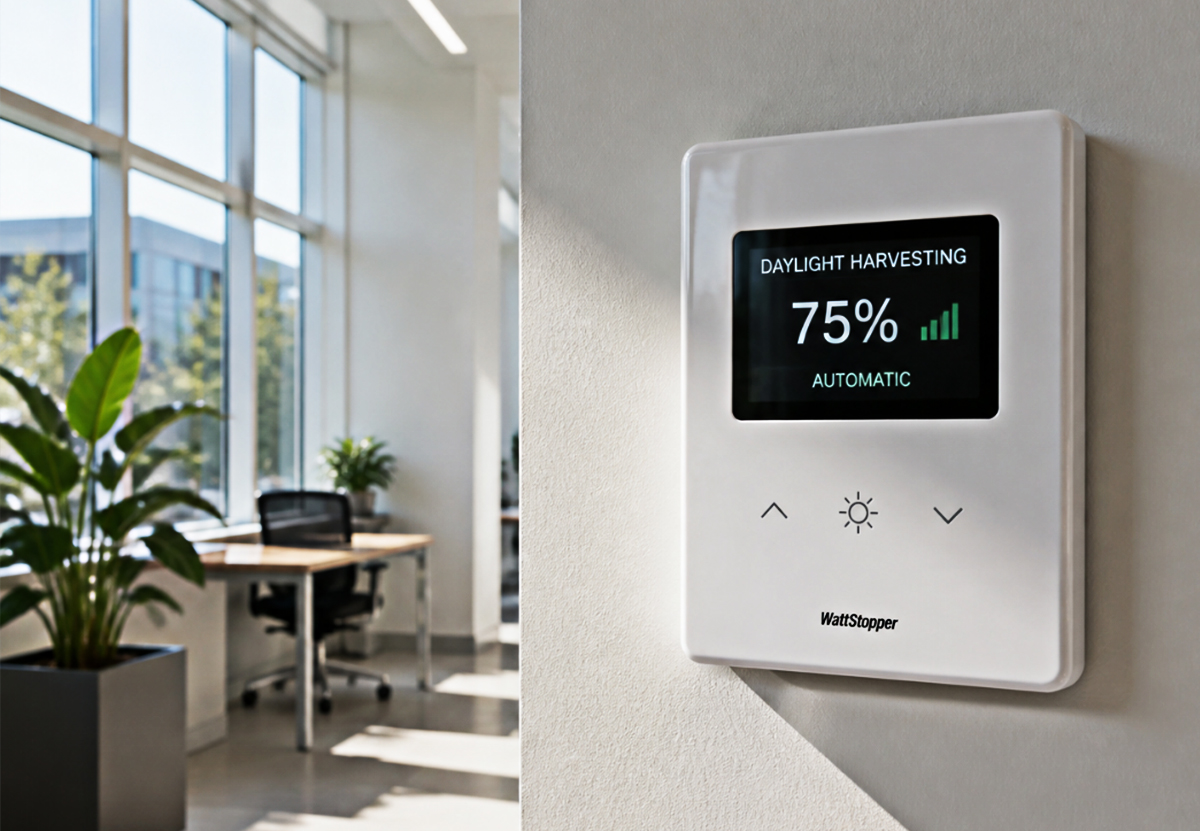
Have you ever walked into a sleek modern office bathed in natural sun, only to look up and see electric lights burning at maximum brightness?
It is a glaring waste of energy, and one that happens every single day in commercial buildings around the world.
For years, commercial lighting design operated on a simple, binary principle: switch the lights on at 8:00 AM and leave them running at 100% capacity until closing time. But as building performance standards tighten and operational costs rise, relying on rigid, full-power illumination simply no longer cuts it.
Enter modern daylight harvesting controls.
By pairing daylight sensors with advanced continuous dimming lighting, these intelligent control systems actively measure incoming sunlight and lower artificial light output in real time. Instead of harsh step-dimming or sudden light shut-offs, continuous dimming smoothly scales down fixture power so imperceptibly that occupants never notice the transition, even while your energy meter slows down significantly.
Adopting smart energy efficient lighting controls isn’t just about checking off mandatory energy code requirements like ASHRAE 90.1 or California Title 24. It is about fundamentally improving how buildings operate:
- Slashing Peak Demand: Automatically throttle power draw during the brightest, highest-cost hours of the day.
- Elevating Occupant Comfort: Maintain consistent, glare-free light levels that keep tenants productive and focused.
- Extending Equipment Life: Reduce thermal stress on LED drivers to prolong your system’s operational lifespan.
Whether you are an MEP engineer fine-tuning sensor layouts or a property developer aiming to boost asset ROI, mastering daylight harvesting is one of the highest-impact moves you can make in modern building design.
Let’s break down how these systems work, why the financials make complete sense, and how you can engineer them for maximum efficiency.
The Financial & Architectural Business Case for Daylight Harvesting
Why let free, abundant natural sunlight go to waste while running electric fixtures at full power? For building owners and project developers, integrating a modern daylight harvesting system isn’t just an ecological statement, it is a high-return financial investment that directly improves your bottom line.
By automatically scaling down fixture output when sunbeams flood your perimeter spaces, you unlock significant operational advantages:
- Quantifiable ROI & Rapid Payback: Lighting typically consumes up to 17% of total electricity in commercial facilities. Pairing continuous dimming with daylight sensors delivers direct lighting energy savings between 20% and 60% in perimeter daylight zones. Depending on regional utility rates and rebate programs, overall system payback is often realized within 2 to 4 years.
- Peak Demand Charge Reduction: Utility companies charge premium rates during peak hours, which coincide directly with the brightest afternoon sunlight. Daylight harvesting systematically throttles power consumption during these window-filled hours, flattening your peak demand profile and shielding you from expensive utility surcharges.
- Elevated Building Sustainability Ratings: If you are chasing LEED v4.1 or WELL Building Standard certifications, daylight harvesting is practically mandatory. It earns vital points under Energy and Atmosphere (EA) credits for optimization, while simultaneously addressing Indoor Environmental Quality (EQ) parameters for natural light access.
- HVAC Heat-Load Trade-offs: Standard electric lights dissipate heat. Throttling fixture power reduces internal heat gains, lowering the mechanical cooling load on your HVAC system during peak summer months.
Beyond the balance sheet, natural light increases tenant satisfaction, boosts workplace alertness, and raises property valuation by transforming static real estate into modern, sustainable workspace inventory.
Core Components of Modern Daylight Harvesting Systems
To harvest daylight effectively, an MEP engineering team must combine precise hardware with seamless digital communication protocols. If any single component in the loop falls out of alignment, system performance degrades quickly into annoying light flickers or manual user overrides.
Here is a breakdown of the core hardware architecture:
- Photosensors (Daylight Sensors): The central nervous system of daylight harvesting. These small optical sensors measure illuminance (in foot-candles or lux) and trigger control loops.
- Open-Loop Sensors: Placed outside or facing window glass to measure incoming daylight only. They are immune to interior reflections, making them straightforward to calibrate for multi-fixture zones.
- Closed-Loop Sensors: Ceiling-mounted facing inward to monitor the combined total of daylight and artificial light reflecting off interior work surfaces. They deliver granular feedback but require careful positioning to avoid false readings from shifting furniture or dark clothing.
- Dimming Drivers (0-10V vs. DALI-2): Once the sensor detects excess sunlight, it sends a command to the fixture driver. Choosing the right protocol dictates how smooth that transition feels to occupants.
- 0-10V Analog Dimming: Simple, low-cost, and widely supported. However, it requires dedicated control wiring runs and dims fixtures uniformly by zone rather than individually.
- DALI-2 (Digital Addressable Lighting Interface): Offers bidirectional digital communication. Each fixture driver receives individual addressing, enabling granular zoning changes via software without re-wiring your ceiling grid.
- Automated Motorized Shades: True daylight optimization pairs artificial light dimming with dynamic shade controls. Motorized blinds deploy automatically when direct solar radiation threatens to cause severe visual glare or unwanted solar heat gain, creating a perfectly balanced indoor luminous environment.
By selecting the right combination of photosensor lighting control hardware and digital dimming drivers, you establish a reliable foundation that saves energy silently in the background day after day.
Key Takeaways
- Substantial ROI & Energy Reduction: Implementing a daylight harvesting system yields direct lighting energy savings of 20% to 60% in perimeter zones, offering rapid payback periods alongside peak demand charge reductions and reduced HVAC thermal loads.
- Optimized Core Components: System stability relies on matching the right architecture—choosing between open-loop vs. closed-loop photosensors, selecting reliable 0-10V or digital DALI-2 drivers for continuous dimming, and pairing controls with automated window shades to mitigate direct glare.
- Compliance & Occupant Well-Being: Strategic daylight sensor installation and precise calibration streamline compliance with ASHRAE 90.1 and California Title 24 energy standards, while delivering a comfortable, natural light-enriched workspace that enhances tenant satisfaction and productivity.
Future Outlook & Call to Action
As building management systems evolve, daylight harvesting is transitioning from standalone perimeter control into fully integrated, IoT-driven ecosystems. Future-ready designs will leverage artificial intelligence, real-time weather forecasting data, and dynamic window glazing to predict natural light shifts before they happen, eliminating manual intervention altogether.
Ready to optimize your building’s lighting strategy?
Partner with an experienced MEP engineering team today to conduct a comprehensive daylight zone audit, evaluate your system payback, and implement smart automated daylighting controls that lower your operational overhead while elevating your indoor environment.