Managing a large-scale renovation or a sprawling residential complex often feels like a balancing act between operational costs and resident satisfaction. If you are overseeing multi-family properties, you likely know the frustration of watching a massive, master-metered water bill arrive each month with no way to identify who is using what, or where a hidden leak might be draining your budget.
Have you ever wondered how much revenue is slipping through the cracks of inefficient utility management?
For years, many of us in property management accepted these rising costs as an immovable “cost of doing business.” But as we look toward more sustainable building standards in 2026, the transition to water submetering has shifted from a luxury to a logistical necessity. It isn’t just about tracking gallons; it’s about a smarter implementation of technology that empowers both owners and residents.
By following a clear set of steps, you can transform an unpredictable overhead expense into a streamlined system that promotes water conservation and transparency. In this guide, we will break down how a seamless implementation can lead to immediate cost savings and a more equitable tenant billing experience.
Are you ready to stop guessing and start measuring? Let’s dive into how you can simplify your infrastructure and boost your property’s bottom line.
The Business Case for Modern Utility Management
How often have you looked at a single, massive water bill for your entire complex and felt a sense of powerlessness? When you are overseeing multi-family properties, managing overhead is a constant battle, and water is often the most unpredictable variable. If you aren’t tracking usage at the individual unit level, you aren’t just paying for water, you’re likely paying for undetected leaks, guest overages, and general waste.
Transitioning to a sophisticated utility management strategy isn’t just a technical upgrade; it is a fundamental shift in your business model. By moving away from “pro-rata” or “RUBS” (Ratio Utility Billing Systems) and toward precise water submetering, you stop guessing and start recovered lost revenue.
But why is this shift becoming the gold standard for property management in 2026? Consider the immediate benefits to your bottom line:
- Immediate Cost Savings: On average, properties that switch to submetering see a 15% to 30% reduction in total water consumption. When residents are responsible for their own usage, behaviors change overnight.
- Fair and Accurate Tenant Billing: Have you ever had a single tenant complain about paying for their neighbor’s two-hour showers? Submetering eliminates this friction by ensuring every resident pays only for what they actually use.
- Early Leak Detection: Imagine catching a running toilet in unit 4B before it causes thousands of dollars in structural damage or spikes your monthly bill. Real-time data acts as a 24/7 security guard for your plumbing.
- Increased Asset Value: A property with lower operating expenses and modernized infrastructure commands a higher cap rate and greater interest from savvy investors.
We often think of water conservation as a purely environmental goal, but in the world of professional real estate, it is a powerful financial lever. By empowering your residents with data and accountability, you create a community that values resources as much as you do.
Are you ready to stop subsidizing waste and start capturing the true value of your square footage? Let’s look at the actual implementation process to see how easily these systems integrate into your existing workflow.
Strategic Implementation: The 4-Step Framework
Now that we’ve established the “why,” let’s talk about the “how.” If you’re managing a busy complex, the idea of a massive infrastructure project can feel daunting. You might be asking yourself, “How much downtime will my residents face?” or “Will my current plumbing even support this?”
The good news is that modern implementation has become remarkably non-invasive. By following a structured, 4-step approach, you can move from a master-metered headache to a streamlined, automated system with minimal friction.
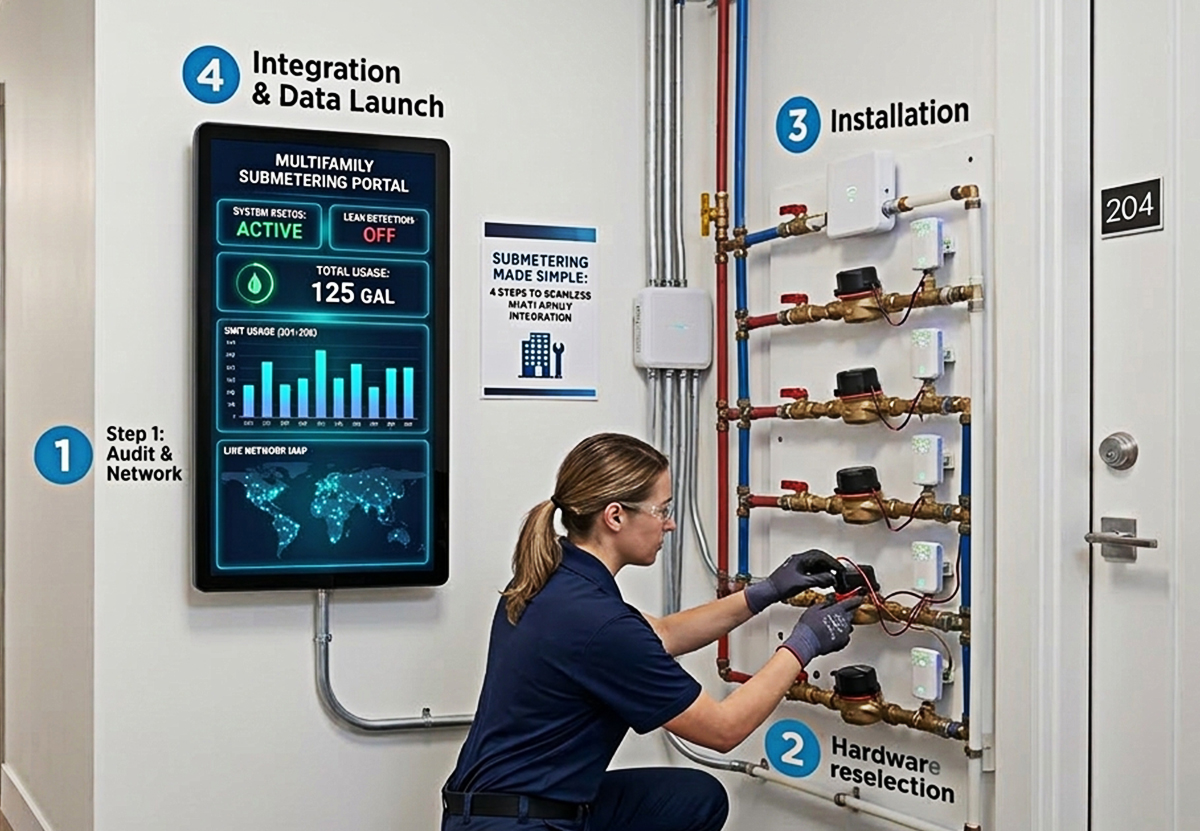
Here is how we break down the transition to water submetering for maximum efficiency:
Step 1: The Infrastructure Audit
Before a single wrench is turned, we must understand the “veins” of your building. A professional technician will evaluate your piping layout, specifically looking for individual unit shut-off valves.
- The Goal: To determine if your multi-family properties are “point-of-entry” (one pipe per unit) or “multi-point” (separate lines for kitchens and baths).
- The Benefit: This audit ensures you choose the right hardware from the start, avoiding costly mid-project pivots.
Step 2: Hardware Selection & Calibration
Not all meters are created equal. Depending on your water quality and pipe size, you might opt for ultrasonic meters (no moving parts) or traditional displacement meters.
We prioritize hardware that offers wireless pulse transmission, allowing for remote utility management without ever needing to enter a tenant’s apartment for a manual reading.
Step 3: Seamless Installation
This is where the plan hits the pavement. Because we focus on efficiency, a typical installation takes less than an hour per unit.
- Notification: We provide residents with a clear timeline.
- Execution: Our teams install the meter and the wireless transmitter.
- Verification: Each unit is tested to ensure data is flowing correctly to the central gateway.
Step 4: System Integration & Data Launch
The final step is connecting your new hardware to your property management software. This is where the magic happens. Your team can now view real-time consumption dashboards, set “high-usage” alerts for leak detection, and prepare for accurate tenant billing cycles.
How would your daily workflow change if you could spot a leak in a vacant unit before it ever hit the floorboards? By formalizing these steps, you aren’t just installing hardware, you’re installing peace of mind.
The Submetering Advantage
As we look toward the landscape of 2026 and beyond, the way we manage our resources is becoming just as important as the way we manage our square footage. Transitioning to a water submetering system is no longer just a trend in property management, it is a strategic move toward long-term resilience and operational excellence.
By taking control of your utility data, you aren’t just cutting costs; you are building a more transparent, sustainable, and profitable community.
Key Takeaways for the Modern Strategist
- Precision Over Estimation: Replace unpredictable master-metered bills with granular, unit-level data that ensures utility management is backed by facts, not averages.
- Behavioral Change: Shift the responsibility of water conservation to the end-user, naturally driving down consumption across your multi-family properties.
- Protection Against Loss: Leverage real-time alerts to catch leaks early, preventing structural damage and preserving your cost savings.
- Seamless Integration: Modern implementation is faster and less intrusive than ever, plugging directly into the software your team already uses.
The future of residential real estate belongs to those who prioritize efficiency and transparency. As building codes tighten and the global focus on resource management intensifies, having these systems in place today will set you apart from the competition tomorrow.
Ready to Take the First Step?
Don’t let another billing cycle pass with your revenue literally going down the drain. Whether you are managing a boutique mid-rise or a massive residential portfolio, the path to a more efficient bottom line starts with a single audit.
Contact our team today to schedule your infrastructure assessment and discover how simple your transition to smart submetering can be.
