
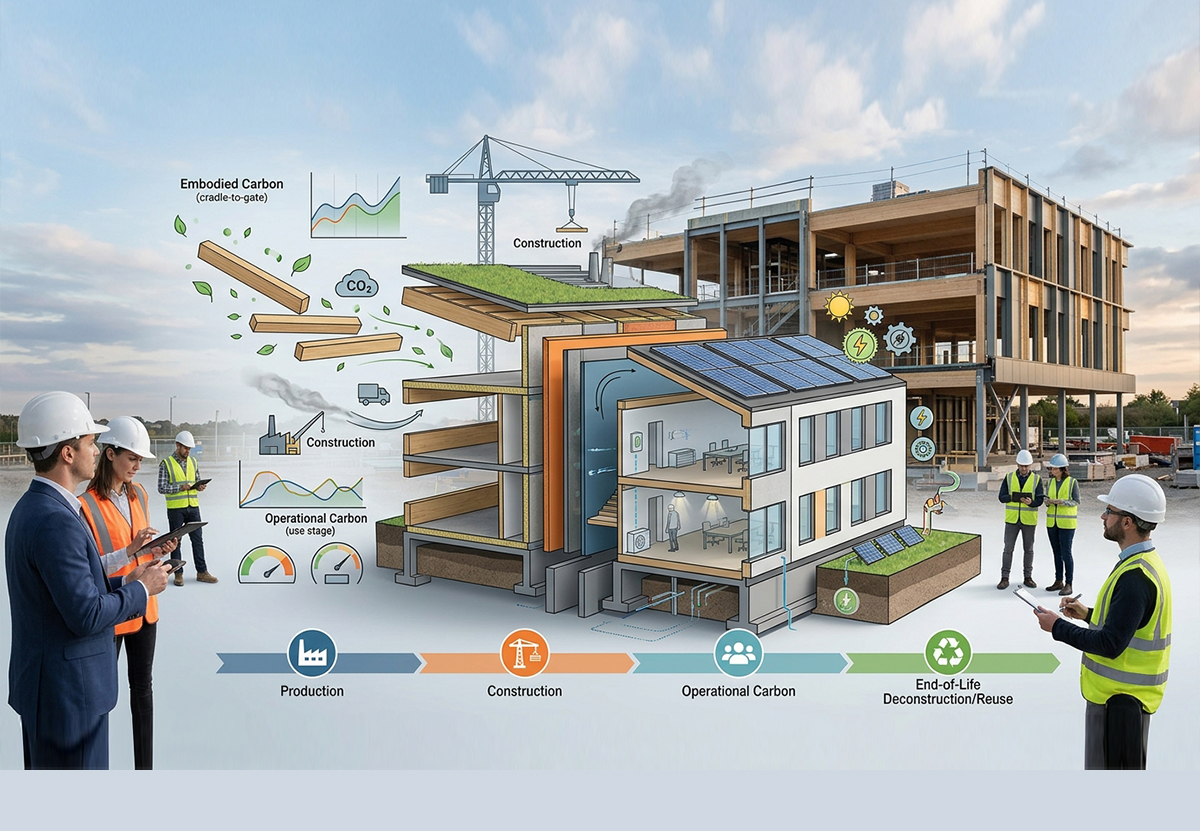
Have you ever wondered whether a “green” building is actually helping the planet, or if it is just hiding a massive carbon footprint behind a curtain of solar panels?
For years, the design and construction industry operated under a single, well-intentioned assumption: if we can generate enough renewable energy on-site to balance out our annual utility bills, we have reached the pinnacle of sustainable architecture. But as our energy grids become cleaner and building technology advances, a glaring blind spot has come into sharp focus. Designing solely for day-to-day operational efficiency ignores the huge wave of emissions released long before a building ever turns on its lights.
This realization is driving a fundamental shift across modern architecture and engineering. We are moving beyond basic operational targets toward a far more holistic, rigorous standard: Net-Zero Whole-Life Carbon.
To truly understand what it takes to build for the future, we have to look past the superficial labels and examine a building’s complete lifecycle footprint. We need to ask harder questions:
- What about the massive upfront emissions created when extracting raw materials, manufacturing steel, and pouring concrete?
- How do we balance the immediate environmental cost of construction against decades of operational performance?
- Are our current industry benchmarks actually keeping pace with global climate goals?
Whether you are an architect, engineer, developer, or sustainability enthusiast, mastering the transition from simple energy conservation to total lifecycle carbon reduction is no longer optional, it is the new baseline for responsible design.
In this article, we will deconstruct the true mechanics of net-zero building. We’ll explore how industry frameworks like the AIA 2030 Commitment and the WorldGBC Advancing Net Zero initiative are reshaping project goals, examine the crucial metrics used to quantify Global Warming Potential, and break down the exact strategies needed to drive both Net-Zero Operational Carbon and upfront emissions down to zero.
Architectural and Engineering Frameworks of Net-Zero Buildings
How do we define a truly sustainable structure in an era of rapidly changing climate targets? To answer this, we must first look at how our industry measures success. For decades, the gold standard centered almost exclusively on Net-Zero Operational Carbon, ensuring a building’s routine energy use for heating, cooling, lighting, and power resulted in net-neutral greenhouse gas emissions over a year.
However, as building envelopes become ultra-efficient and regional power grids transition to renewables, a critical shift is taking place. Pioneering frameworks like the WorldGBC Advancing Net Zero campaign and the AIA 2030 Commitment are pushing design teams toward a more rigorous standard: Net-Zero Whole-Life Carbon.
To navigate this evolving landscape, modern project teams evaluate four core architectural and engineering pillars:
- Whole-Life vs. Operational Boundaries: Moving beyond utility bills to measure every phase of a building’s existence, from resource extraction to eventual demolition.
- Upfront vs. Long-Term Impacts: Weighing the immediate carbon “debt” of heavy construction against the gradual operational savings accrued over decades.
- Standardized Measurement: Establishing a baseline for Global Warming Potential to benchmark materials and assemblies accurately.
- International Alignment: Mapping project goals directly against global climate roadmaps to ensure long-term regulatory compliance and asset value.
Evaluating these parameters early in the conceptual phase prevents teams from accidentally “locking in” high-carbon materials simply to achieve minor operational gains.
Engineering Strategies to Balance Operational Energy Use
Once a holistic framework is established, how do engineers optimize daily building performance without causing unintended carbon spikes elsewhere? Achieving an operational equilibrium requires balancing extreme efficiency with smart, flexible energy systems.
Rather than simply covering a roof in solar panels to offset a leaky building design, modern engineering prioritizes passive performance first, followed by active dynamic management:
- Envelope Optimization: Designing continuous insulation, high-performance glazing, and thermal-bridge-free connections to drastically drop baseline heating and cooling demands.
- Electrification and Dynamic HVAC: Replacing fossil-fuel combustion with variable-refrigerant-flow (VRF) systems and heat pumps that adjust output based on real-time occupancy.
- Smart Grid Integration: Utilizing thermal energy storage and load-shifting algorithms so the building draws power when the municipal grid is cleanest.
- On-Site Generation: Deploying photovoltaic arrays to produce Exported Renewable Energy, feeding clean electricity back into the local grid during peak production hours.
By treating the building as an active participant in the energy ecosystem rather than a passive consumer, engineers can eliminate operational emissions while laying a clean foundation for whole-life carbon neutrality.
Key Takeaways
Decarbonizing the built environment requires a fundamental shift in how we conceptualize, design, and construct buildings. Moving from basic energy conservation to complete lifecycle neutrality demands a new level of precision across every discipline.
- Whole-Life Carbon is the New Standard: Achieving true net-zero requires balancing both upfront embodied carbon in materials and operational emissions throughout the building’s entire lifecycle.
- Passive Performance First: Engineering strategies must prioritize continuous thermal envelopes and electrification before relying on renewable energy generation to balance operational loads.
- Material Selection Matters Upfront: The choices made during early architectural design, favoring bio-based materials, dematerialization, and circular design, set a project’s permanent carbon budget.
- Continuous Measurement Drives Success: Utilizing robust Life Cycle Assessments (LCAs) ensures design decisions align with global frameworks like Architecture 2030 and local climate regulations.
The Road Ahead: Designing for Tomorrow
The future of architecture and engineering lies in moving beyond “less harm” toward regenerative design. As municipal codes tighten and grid decarbonization accelerates, whole-life carbon tracking will soon transition from a voluntary best practice to a standard regulatory requirement.
Ready to lead the shift toward true net-zero design? Start by auditing your current project workflows to incorporate early-stage Life Cycle Assessments. Prioritize low-carbon structural materials, align your project goals with frameworks like the AIA 2030 Commitment, and ensure every design choice supports a fully decarbonized built environment. The decisions we make on the drawing board today will define the carbon footprint of our cities for generations to come.